Testing Product Market Fit with a New Audience
The company was building a new product for job seekers. The product included a free tier and a paid tier. The team needed to understand whether job seekers understood what was being offered at each tier, and whether they saw enough value to be willing to pay for it.
At a glance
Problem. A new paid product for job seekers rested on an untested bet: that candidates would sign up, then pay to be verified.
What I did. Walked job seekers through a prototype of the full journey and tracked whether they understood what we were offering at each step, where they hesitated, and what they compared it to.
Outcome. Showed that the value we thought we were offering wasn't enough for job seekers, and that the team needed a more competitive angle.
Research question
Do job seekers understand the free and paid tiers, and do they value the features?
- Free tier: are the free tier features enough to get someone to sign up?
- Paid tier: are people comfortable verifying their identity, where do they hesitate, and do they think it is worth paying for?
Approach
Each 45-minute session started where the product would: right after the participant finished a job application. They then moved through the five steps of the prototype, thinking aloud.
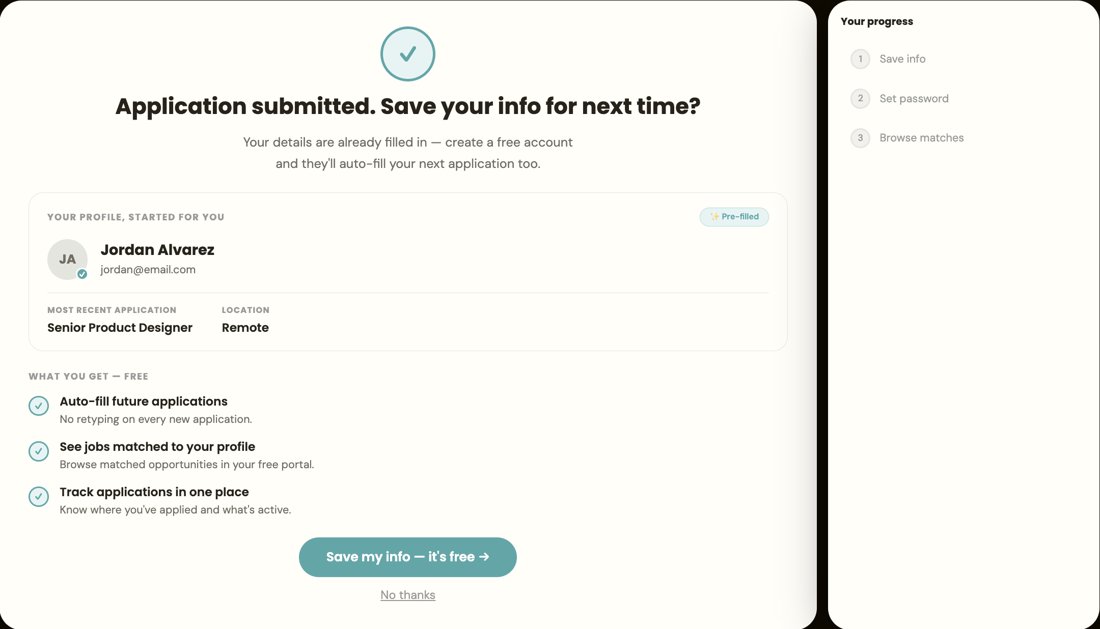 1 · Save your info
after finishing an application
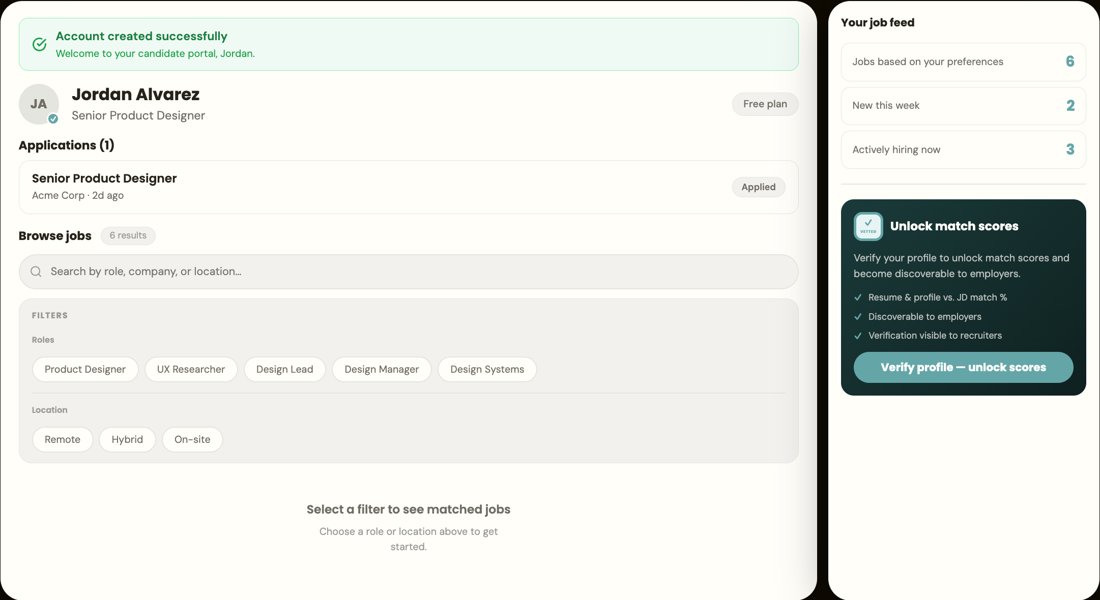 2 · Free dashboard
applications, job feed and filters
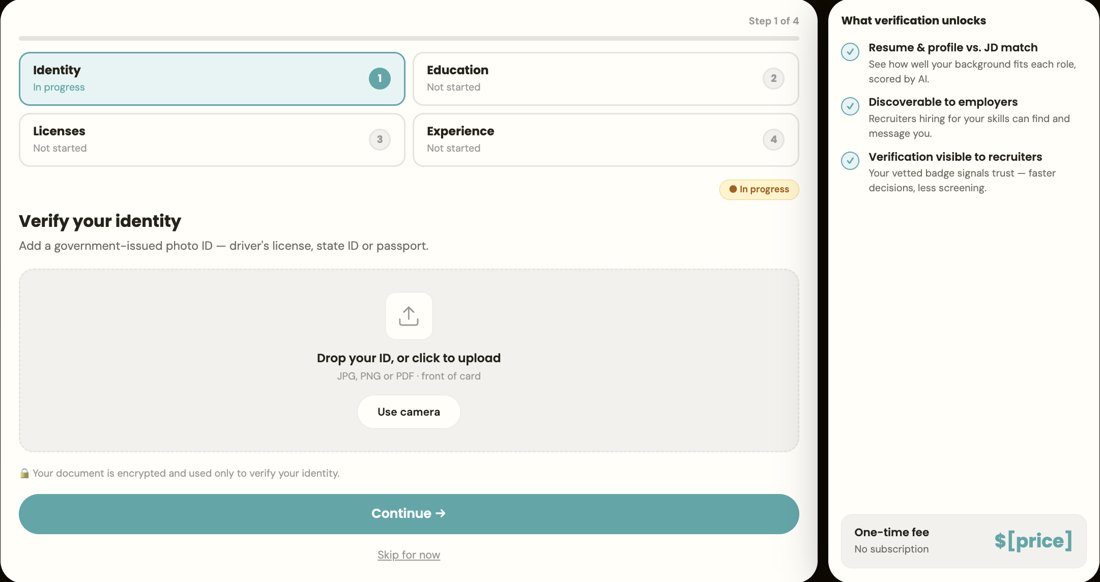 3 · Verification
identity, education, licences, experience
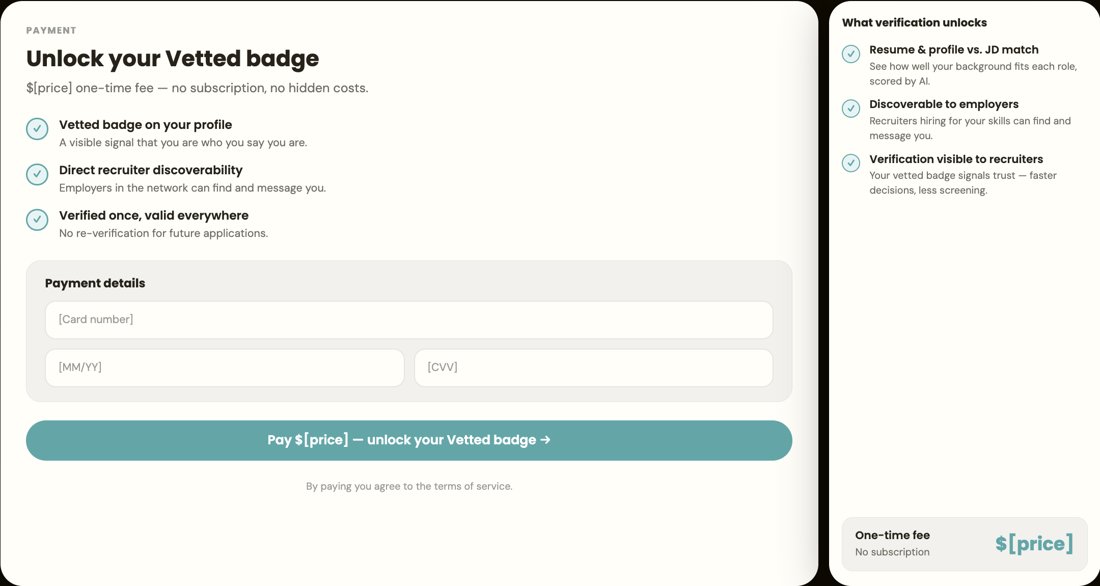 4 · Payment
one-time fee for the verified badge
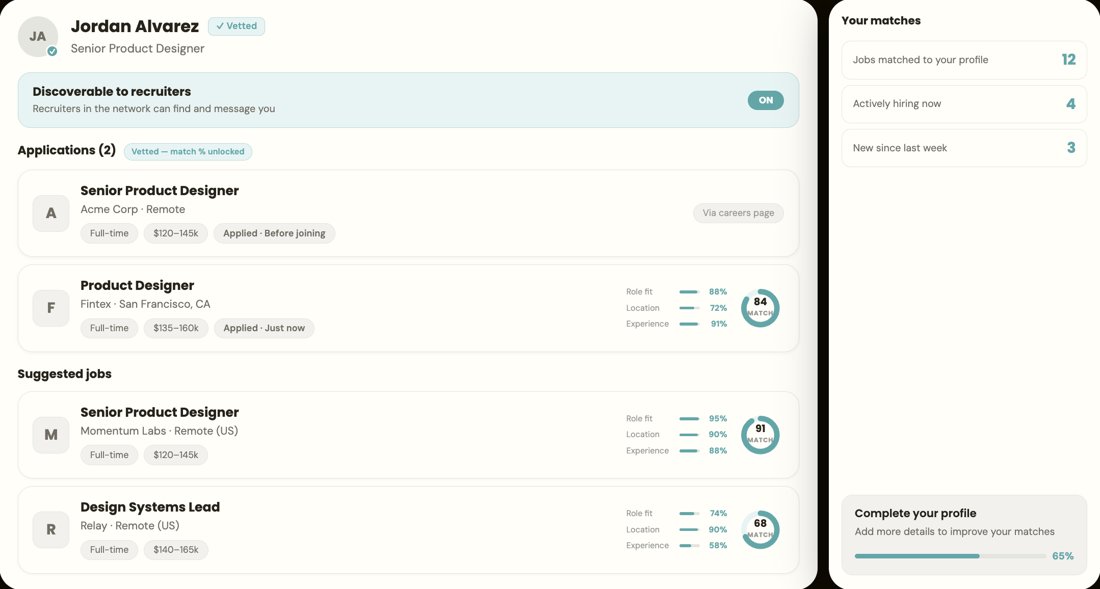 5 · Verified dashboard
match scores and recruiter discoverability
Decisions that shaped the study
Frame the study around the business risk
The question that mattered was "will candidates sign up, then pay?", not "do they like it?". So I tracked understanding and hesitation at each step of the journey, where a real candidate would drop off.
Recruit fast, then weight the findings for it
Results were needed before design and vendor decisions, so I recruited recent hires at our own company who had just been through a high-volume job search. Internal participants tend to be more favourable, so I gave less weight to enthusiasm and more to what confused people or made them hesitate, and said so in the readout.
Compare against what job seekers already use
Participants kept comparing the prototype to tools they had used in their search. I turned those comparisons into a competitive analysis, so the team could see where the offer was already available for free.
What we learned
| Job seeker wants to… | Feature | Reaction |
|---|---|---|
| Save time and apply early | Application pre-fill Free | Clearest value. Easy to say yes to. |
| Apply to the right jobs | Filters Free and match scores Paid | Useful, but scores must be transparent, and a competitor already gives them away free. |
| Be seen by recruiters | Verified profile Paid | Wanted, but trust and fairness concerns dominated. |
| Avoid fraud and stale postings | Job listings | If they pay, they expect employers to be verified too. |
| Product | What participants said | Match scores | Verification | Cost to job seekers |
|---|---|---|---|---|
| JobRight | Closest to our matching; strong match %, weak title search | Yes | None | Free tier; paid about $30/month |
| LinkedIn Easy Apply | Applications feel unseen, but the benchmark for status updates | AI job matching | Free profile verification badge | Free; Premium optional |
| Greenhouse | Autofill better than LinkedIn's; the trusted-brand benchmark | Job alerts | ID check, if the employer turns it on | Free |
| Workday | Named the worst: no autofill, parsing errors | Recommendations | None | Free |
| ADP | Deep pre-fill saved about 15 minutes per application | None | None | Free |
| Teal | Strong resume tools, weak matching | Resume-to-job scorer | None | Free tier; paid about $29/month |
Conclusion
The study tested the core bet before the team invested in higher-fidelity design and verification vendors. The free tier was worth building on, but the paid tier, as designed, wasn't a strong enough reason to pay, especially when competitors offered similar features for free. The team decided not to launch the verified network as designed, and went back to develop new ideas for a more competitive offer.
How confident to be
- Internal participants.
- They may be more favourable toward a company concept, and all of them were successful job seekers. That's why the findings lean on hesitation and comprehension, which hold up better than enthusiasm.
- A prototype, not a product.
- Nobody actually paid or uploaded an ID, so willingness to pay is stated, not observed.
What I'd do next
- Validate externally at higher fidelity, with job seekers who don't work here and aren't already hired.
- Test less invasive verification. If "verified" mainly means "not a bot", email or other lighter checks may be enough, and may remove the trust barrier.
- Study sponsored listings. Find out whether paid placements change how much job seekers trust the platform, because leadership wanted to prioritize sponsored ads over organic matches.